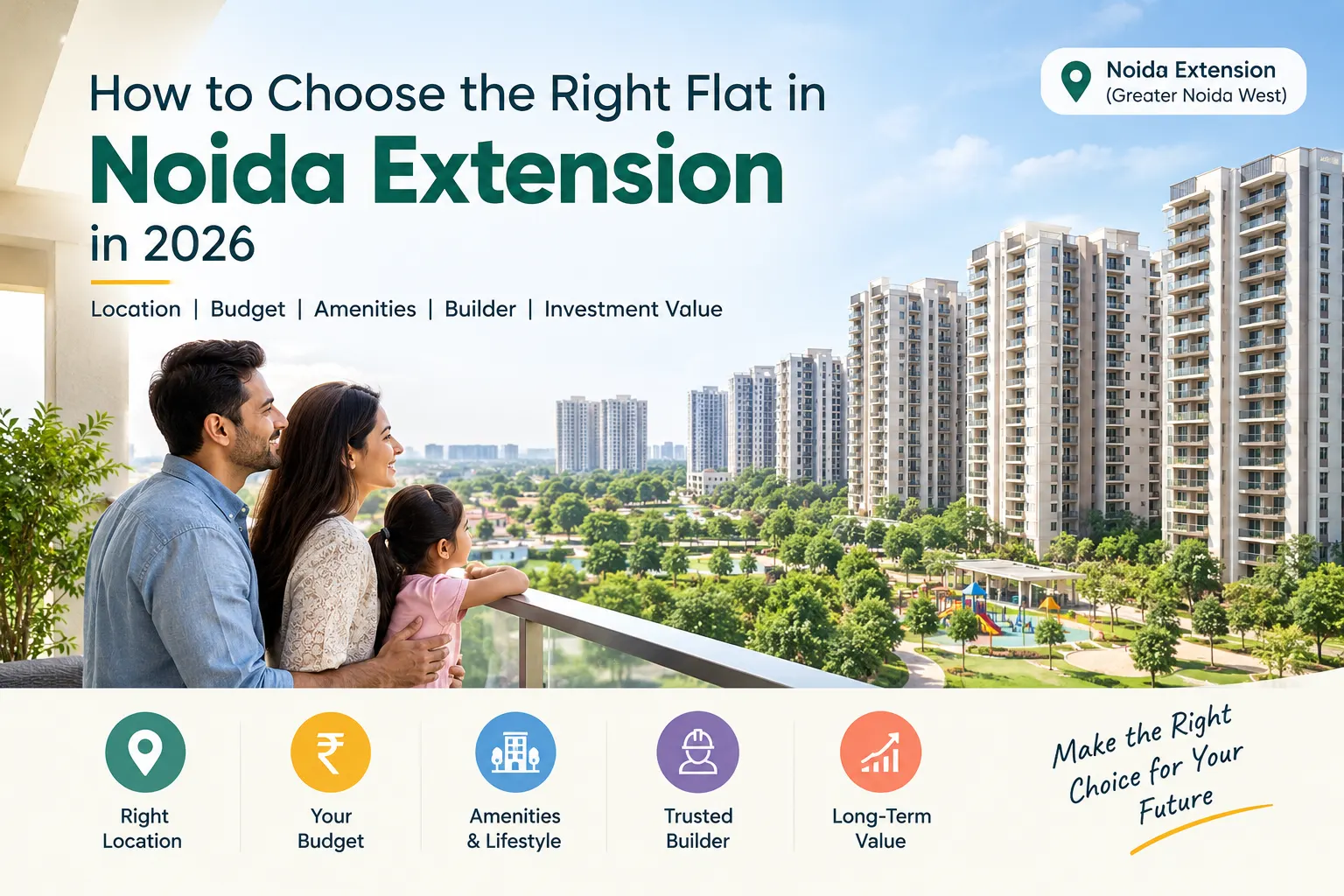
How to Choose the Right Flat in Noida Extension in 2026
Buying a home is one of the most important decisions in life. Whether you are purchasing your first apartment, planning to move into a bigger home with your family, or looking for a property closer to your workplace, choosing the right flat requires careful planning.
Noida Extension, also known as Greater Noida West, is a residential destination that many homebuyers consider because of its range of apartment options, residential societies, and access to nearby areas of Noida and Greater Noida.
However, with so many residential projects and configurations available, finding the right home can feel overwhelming. You need to consider more than just the price or appearance of an apartment. Location, construction quality, connectivity, amenities, legal documents, and long-term living requirements all matter.
In this guide, Realty Express explains how to choose the right flat in Noida Extension in 2026, helping you make a more informed decision for yourself and your family.
1. Set Your Budget Before Searching for a Flat
The first step in buying a flat is deciding how much you can comfortably afford.
Property prices vary depending on the project, location, apartment size, floor, amenities, construction status, and other factors. Instead of selecting a property based only on its advertised price, calculate the total cost of ownership.
Consider the following expenses:
- Basic property price: The advertised cost of the apartment.
- Registration and stamp duty: Applicable government charges.
- GST: Applicable to eligible under-construction residential properties; generally, GST does not apply to the sale of a completed property where the entire consideration is received after the completion certificate or first occupation, as prescribed by law.
- Parking and other charges: Check whether parking, club membership, power backup, or other facilities involve additional costs.
- Maintenance charges: Understand the monthly or annual maintenance expenses.
- Home loan expenses: Consider interest, processing fees, insurance if applicable, and other borrowing costs.
- Interior and moving expenses: Budget for wardrobes, furniture, appliances, and any required renovations.
Homebuying tip: Keep an emergency fund instead of using all your savings for the down payment. Your monthly EMI should leave enough money for household expenses, education, healthcare, and other financial commitments.
2. Choose the Right Location in Noida Extension
The right location depends on your daily routine and family needs. A flat that looks attractive on paper may not be suitable if commuting to work or accessing essential services becomes difficult.
Before choosing a residential society, evaluate:
Connectivity to your workplace
Check the actual travel time to your office during peak hours. Consider access to major roads, public transport, and routes connecting Noida, Greater Noida, and nearby employment areas.
Schools and colleges
For families with children, check the distance to schools, childcare facilities, and other educational institutions.
Hospitals and healthcare
Look for accessible hospitals, clinics, pharmacies, and emergency healthcare services.
Shopping and daily necessities
Nearby grocery stores, supermarkets, banks, parks, and other everyday facilities can make family life more convenient.
Traffic and road access
Visit the location during morning and evening peak hours. Observe road conditions, congestion, construction activity, and access to the society.
Pro tip: Do not rely entirely on a project’s brochure or map. Visit the actual location and assess the surrounding area before making a booking decision.
3. Decide Whether You Need a 2 BHK or 3 BHK Flat
Choosing the correct apartment configuration is important because your home should meet your needs today and remain practical for the coming years.
2 BHK flats
A 2 BHK apartment may be suitable for couples, small families, first-time homebuyers, or people who prefer a manageable home size and budget.
Consider a 2 BHK if:
- You have a small family.
- You want to keep the purchase price and maintenance expenses manageable.
- You do not require an additional bedroom or dedicated home office.
3 BHK flats
A 3 BHK apartment may be a better choice for growing families or buyers who need additional space.
Consider a 3 BHK if:
- You have children or family members living with you.
- You need a separate study or work-from-home room.
- You regularly host guests.
- You expect your space requirements to increase.
Before comparing apartments, check the carpet area, room dimensions, ventilation, storage space, and usable layout. A larger advertised area does not automatically mean that the apartment will feel more spacious.
4. Compare Residential Projects and Amenities
Amenities can improve your quality of life, but the facilities you actually use should take priority over impressive marketing brochures.
Depending on the project, useful facilities may include:
- 24-hour security and controlled entry
- Lift availability and maintenance
- Power backup for essential services
- Reliable water supply
- Dedicated parking arrangements
- Children’s play areas
- Walking paths and landscaped gardens
- Fitness facilities or a gym
- Community spaces
- Fire safety systems and emergency access
Ask whether the advertised facilities are operational, included in the purchase price, or subject to additional charges.
It is also important to check the condition of common areas, the quality of society management, and the maintenance arrangements.
Remember: A well-maintained residential society with essential facilities may suit your family better than a project with numerous amenities that are expensive to maintain.
5. Check the Builder’s Reputation and Project Details
Before booking a flat, research the developer and the specific residential project.
Do not rely only on advertisements, sales representatives, or online reviews. Try to verify the information independently.
Check the following:
- The developer’s previous projects and delivery record.
- The quality and maintenance of completed developments.
- The project’s construction status.
- Whether the promised facilities match the actual project.
- Any publicly available information about delays, disputes, or unresolved complaints.
- The terms and conditions stated in the booking documents and agreement.
If possible, speak with residents of the developer’s completed projects. Their experience may provide useful insight into construction quality, maintenance, water supply, and the developer’s responsiveness.
6. Verify Legal Documents Before Booking
Legal verification is one of the most important parts of buying a property. Never assume that a project is legally suitable simply because it is advertised online or recommended by an agent.
Before paying a booking amount, verify the relevant documents with an independent property lawyer.
Depending on the property and transaction, important checks may include:
- UP-RERA registration: Verify the project on the official Uttar Pradesh Real Estate Regulatory Authority website where registration is applicable.
- Land title and ownership: Confirm that the seller or developer has the legal right to sell the property.
- Approved building plans: Check the relevant approvals for the project.
- Completion or occupancy certificate: Verify the applicable certificate for a completed property.
- Encumbrances and outstanding dues: Check for relevant mortgages, claims, or unpaid charges.
- Agreement for sale: Carefully review payment schedules, possession terms, carpet area, cancellation conditions, and other obligations.
- Property-specific documents: Confirm the documents required for the particular project, resale transaction, or authority-allotted property.
For under-construction properties, verify the project’s current status and the disclosures available through the official RERA portal.
You can visit the official UP-RERA website at https://www.up-rera.in/ to search for registered projects and review available information.
Important: RERA registration is an important check, but it does not replace independent legal verification of the property’s title, approvals, and transaction documents.
7. Understand the Difference Between Ready-to-Move and Under-Construction Flats
Both options have advantages and limitations. Your choice should depend on your move-in timeline, budget, and comfort with construction-related uncertainty.
Ready-to-move flats
Potential advantages:
- You can inspect the actual apartment before purchasing.
- You can assess the building and common facilities.
- You may be able to move in sooner, subject to the required documentation.
- You can observe the surrounding neighbourhood and existing residents.
Things to check:
- Applicable completion and occupancy documentation.
- Building maintenance and construction quality.
- Existing utility connections and outstanding dues.
- The condition of the apartment and common areas.
Under-construction flats
Potential advantages:
- You may have a wider choice of available layouts, floors, or units, depending on the project.
- The payment schedule may be linked to construction milestones, subject to the agreement.
- You may have more time to plan your move.
Things to check:
- Construction progress and the declared completion timeline.
- RERA disclosures and project approvals.
- The developer’s delivery history.
- Payment obligations and consequences of delays.
- The agreement’s possession and compensation provisions.
Neither option is automatically better. Compare the complete cost, documentation, delivery timeline, and suitability for your family’s needs.
8. Inspect the Flat Before Making a Final Decision
If you can visit the actual apartment, inspect it carefully. For an under-construction property, inspect the sample flat but remember that its finishes, furnishings, and layout may differ from the apartment being sold.
Pay attention to:
- Natural light and ventilation.
- Room dimensions and furniture placement.
- Kitchen space and storage.
- Bathroom fittings and water pressure.
- Doors, windows, flooring, and visible cracks.
- Electrical points and ventilation systems.
- Balcony safety and usability.
- Mobile network reception.
- Noise from roads, nearby construction, or common areas.
- Lift access, parking, and emergency exits.
For a resale apartment, ask about previous repairs, water leakage, maintenance dues, and any alterations made to the property.
Consider hiring a qualified home inspector or technical professional if you need help assessing construction quality.
9. Compare Home Loan Options and Monthly EMI
If you plan to finance your purchase, compare home loan offers from multiple lenders instead of choosing solely on the advertised interest rate.
Review the following:
- Interest rate and whether it is fixed or floating.
- Loan tenure and total interest payable.
- Processing and other applicable fees.
- Prepayment and foreclosure conditions.
- Required down payment.
- Loan eligibility and documentation.
- Whether the lender has approved the specific project, where applicable.
Use an EMI calculator to estimate your monthly repayment under different interest rates and tenures.
Do not stretch your budget simply to buy a larger apartment. A comfortable EMI is important for maintaining financial stability after you move into your new home.
10. Consider Your Family’s Future Needs
A home should work for your family beyond the day you purchase it.
Think about your requirements over the next five to ten years, without assuming that your needs or property values will remain unchanged.
Ask yourself:
- Will the apartment provide enough space if your family grows?
- Is there room for working or studying from home?
- Can elderly family members access the building comfortably?
- Are schools, healthcare, and daily necessities conveniently accessible?
- Is the society suitable for your preferred lifestyle?
- Will maintenance and commuting expenses remain manageable?
- Is the apartment practical for your likely future circumstances?
The right flat is not necessarily the largest or most expensive one. It is the property that balances affordability, comfort, location, and your family’s needs.
Common Mistakes to Avoid When Buying a Flat in Noida Extension
Before making your final decision, avoid these common mistakes:
- Choosing a flat based only on the advertised price.
- Paying a booking amount without checking the relevant documents.
- Ignoring the difference between carpet area and super built-up area.
- Relying on promised possession dates without reviewing the agreement.
- Overlooking maintenance charges and additional costs.
- Skipping an actual site visit.
- Ignoring the daily commute and nearby facilities.
- Taking a home loan with an EMI that strains your monthly budget.
- Relying entirely on a broker or developer for legal advice.
- Making a rushed decision because of a limited-period offer.
Taking time to compare properties and verify the details can help you avoid costly mistakes.
Final Thoughts
Choosing the right flat in Noida Extension in 2026 requires a balance of budget, location, apartment configuration, construction quality, legal verification, and everyday convenience.
Start by understanding your family’s requirements and setting a realistic budget. Shortlist suitable residential projects, visit the locations, compare the actual apartments, and verify all relevant documents before booking.
A carefully selected home can provide comfort and convenience for years to come. The key is to make a decision based on verified information rather than promotional promises.
Looking for your ideal home in Noida Extension?
Explore residential listings and apartment options on Realty Express to compare properties, review project details, and shortlist homes that match your budget and requirements.
Visit: https://realtyexpress.in/
Frequently Asked Questions (FAQs)
1. Is Noida Extension a good place to buy a flat for a family?
Noida Extension may suit families looking for apartment options in Greater Noida West. Evaluate the specific society’s connectivity, schools, healthcare access, maintenance, security, and total cost before making a decision.
2. Should I buy a 2 BHK or a 3 BHK flat in Noida Extension?
A 2 BHK may suit a smaller family or a buyer with a tighter budget, while a 3 BHK may offer more flexibility for growing families or people needing a home office. Compare the usable area and total cost rather than bedrooms alone.
3. What should I check before booking a flat in Noida Extension?
Check the total purchase cost, builder’s record, project approvals, applicable UP-RERA details, property documents, carpet area, possession terms, amenities, and maintenance charges. Consult an independent property lawyer before committing.
4. Is a ready-to-move flat better than an under-construction flat?
A ready-to-move flat allows you to inspect the actual property and existing facilities. An under-construction flat may offer more unit choices, but requires careful checks of approvals, construction progress, payment terms, and possession timelines.
5. How do I verify a residential project’s RERA registration in Uttar Pradesh?
Visit the official UP-RERA website at https://www.up-rera.in/ and search for the project using its name or registration details. Review the available project disclosures and seek independent legal advice for additional verification.
6. What additional costs should I consider when buying a flat?
Depending on the property and transaction, costs may include stamp duty, registration, applicable taxes, parking or facility charges, maintenance, home loan fees, and interior work. Ask for a detailed cost sheet before booking.
7. How can I choose the right floor in an apartment building?
Consider lift reliability, accessibility, natural light, ventilation, noise, water pressure, fire safety, and your family’s needs. Visit the property and assess the advantages and disadvantages of the specific floor before deciding.

Recent Posts


How to Choose the Right Flat in Noida Extension in 2026